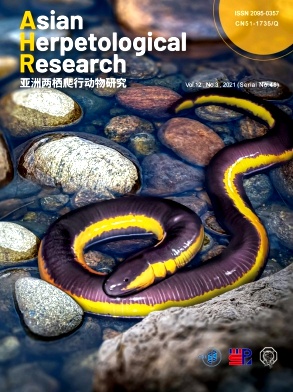
刊名:Asian Herpetological Research
网址:http://www.ahr-journal.com/en/default.asp
统计信息期刊文章(文章为近两年的文章,共26篇)
Haoqi YU; Yiheng LIN; Shengchao SHI; Bicheng ZHU; Bin WANG; Jianping JIANG; Feng XIE
Asian Herpetological Research 2025年第16卷第3期 DOI:
关键词: biodiversity;;morphology;;new species;;phylogenetic analysis;;taxonomy
摘要: We describe a new frog species of Ceratobatrachidae, assigned to the genus Liurana, from Medog, Xizang, China. The new species can be distinguished from its congeners by:(1) smaller body size;(2) head length smaller than head width;(3) tibiotarsal articulation reaching between the eye and nostril when adpressed;(4) distinct tympanum;(5) digital disc absent;(6) metacarpal tubercles absent;(7) metatarsal tubercles indistinctive;(8) supernumerary tubercles below the base of finger absent; and(9) finger I much shorter than finger II. Phylogenetic analyses based on a single mitochondrial gene, as well as the combined sequences of one mitochondrial and two nuclear genes, both support the new species as an independent lineage. In addition, the uncorrected genetic distance of COI between the new species and the closest congener, L. xizangensis, was 9.4%. The discovery of another new species of the genus Liurana from the same region suggests that the diversity within this genus requires more comprehensive investigation.
Peng GUO; Kai WANG; Songwen TAN; Yayong WU; Jing CHE
Asian Herpetological Research 2025年第16卷第3期 DOI:
关键词: lizard;;new record;;new species;;phylogeny;;Qinghai-Xizang Plateau;;taxonomy
摘要: The genus Ablepharus represents a morphologically diverse group of lizards, comprising approximately 19 species distributed across Asia. However, due to challenges in sample collection, the taxonomy and phylogeny of this genus remain poorly resolved. In this study, we identified and described a novel species of Ablepharus from western Xizang, China, through morphological analysis and molecular phylogenetics. Phylogenetic reconstruction based on mitochondrial DNA(ND2) sequences showed that the new species formed a strongly supported sister lineage with A. ladacensis and A. himalayanus, while exhibiting significant genetic divergence from all other congeners. In addition to its genetic distinctiveness, the new species can be characterized by a combination of the following morphological characters:(1) eyelids partially fused;(2) tympanum sunken;(3) supranasal scales absent;(4) prefrontals separated from each other;(5) supraoculars 4;(6) supralabials 7, 6<sup>th</sup> largest;(7) infralabials 6 or 7;(8) scale rows across neck and back 6;(9) scales encircling midbody 32;(10) midventral scales from last chinshield to precloaca 72–80;(11) subcaudals 110–125;(12) lamellae beneath 4<sup>th</sup> finger 13–16, beneath 4<sup>th</sup> toe 18–21;(13) body brownish-olive, devoid of spots, venter brick-red. This study highlights the underexplored species diversity within Ablepharus in China and provides new insights into the taxonomy and evolutionary relationships of the genus.
Ganggang YANG; Chong CUI; Qiuya WANG; Jiaoying HE; Baiyun XUE; Zhengfei WANG; Xiaohong CHEN; Zhuo CHEN
Asian Herpetological Research 2025年第16卷第3期 DOI:
关键词: mitogenome;;Odorrana nasuta;;phylogenetic relationship;;rearrangement
摘要: Mitogenomes have been widely used in phylogenetic and taxonomic research, due to their maternal inheritance, accelerated evolutionary rates, compact circular structure, and the absence of introns. Although their utility is well-established, efficient mitogenome sequencing still poses a challenge for evolutionary studies. Here, we presented a novel hybridization capture protocol that enables highfidelity sequencing of the complete mitogenome(16 535 bp) of Odorrana nasuta. This genome exhibits typical anuran characteristics, including an A + T nucleotide bias(56.37%) and conserved gene composition. Notably, we identified a lineage-specific trn H transposition event that reorganizes the typical gene order into a unique trn H-trn L1-trn T-trn P-trn F cluster, which may be a potential synapomorphic trait for the genus Odorrana. Phylogenetic reconstruction using 13 protein-coding genes from 59 anuran species strongly supported the monophyly of Ranidae and its constituent genera(Odorrana, Rana, Lithobates, Amolops, Pelophylax, Glandirana), yet reveals the incongruence in the placement of Hylarana. The conflicting topologies observed for Hylarana and Glandirana across different studies highlight critical methodological limitations, including taxonomic sampling biases and data type dependency, which collectively compromise phylogenetic resolution. By integrating mitogenomic structure signatures with sequence-based phylogenies, this work advances our understanding of the systematics within Odorrana and highlights the need of multi-locus genomic datasets for resolving deep phylogenetic conflicts within Ranidae.
Shihang XU; Rongchuan XIONG; Caiwen ZHANG; Xiaojuan XIANG; Hong CHEN; Baowei ZHANG
Asian Herpetological Research 2025年第16卷第3期 DOI:
关键词: morphology;;Natricinae;;phylogenetics;;Rhabdophis shuichengensis sp. nov.;;taxonomy
摘要: This study describes Rhabdophis shuichengensis sp. nov. a new species from Guizhou Province, China. This new species is distinguished from other congeners by the following characters:(1) medium-sized body(SVL of adult males: 579–643 mm and adult females: 530 mm);(2) uniformly grayish brown above, black line below eye and between last two labials absent;(3) dorsal scale rows of 15-15-15;(4) ventral scales of 154–158;(5) subcaudal scales of 43–56;(6) supralabials scales 6;(7) infralabials scales 8;(8) preoculars scales 1, postoculars scales 3, and supraocular scales 1;(9) temporal scales 1 + 2;(10) dorsal scales are keeled, with uppermost 5 rows feebly keeled;(11) abruptly enlarged, blade-shaped posterior two maxillary teeth, not preceded by a diastema and maxillary tooth count 20–22(18–20 + 2). The description of this new species brings the total number of described species of this genus to 35 and represents the 14 th known Rhabdophis species in China.
Mohammad A.ABU BAKER; Sajeda J.JABER; Ahmad A.KATBEH-BADER; Ahmad M.DISI; Zuhair S.AMR
Asian Herpetological Research 2025年第16卷第3期 DOI:
关键词:
摘要: Dear Editor, Life-history studies including dietary preferences and trophic interactions are essential for understanding community ecology in lizards(Pianka, 1986). The family Agamidae is one of the largest in terms of species diversity and occurs in a variety of habitats(Uetz et al., 2024). Members of the family Agamidae that feed mostly on ground-dwelling insects are ambush(sit-and-wait) predators that rely on visual scanning, i. e., remaining motionless, elevating their bodies, and raising their heads while scanning their surroundings until prey is spotted(Herrel et al., 1998; Ibrahim and El-Naggar, 2013).
Tong LIU; Xiaolong ZHAO; Jinyan YANG; Yiqiong CUI; Min CHEN; Zhigao ZENG
Asian Herpetological Research 2025年第16卷第2期 DOI:
关键词: climate change;;conservation priorities;;lizards;;multidimensional biodiversity;;Qinghai-Xizang Plateau
摘要: Global framework for nature management requires identifying areas of high priority for biodiversity conservation and restoration.The unique environments of Qinghai-Xizang Plateau(QXP) provide irreplaceable habitats for biodiversity which is prominent under future climate change.Despite the recent increase in research interest on conservation priorities,there is a lack of comprehensive and targeted protection strategies for pandemic species under climate change.Here,we compiled an exhaustive dataset with the variables of extinction risk and occurrence records of ectothermic lizards to investigate the conservation priorities in the QXP.We assessed the conservation status of the QXP lizards and identified the priority protected areas within the QXP under future climate scenarios using phylogenetic generalized least squares and ensemble species distribution models.Our analyses suggested nine lizard species to be prioritized for protection,with the most critical priority species being Dopasia gracilis,D.harti,and Phrynocephalus putjatai.Moreover,the priority protected areas covered~4.7%area of the QXP,mostly in the southern QXP and southeastern Hengduan Mountains.Protecting these regions would achieve a conservation effectiveness of≥95%for species richness,phylogenetic and functionaldiversity under climate change.Our findings provide realistic guidance for improving the conservation effectiveness of specific-lizard and-regions in the QXP under climate change.Our“bottom-up”approach could help the conservation efforts of other regions and species as an alternative to“top-down”global maps.
Wenbo LIAO; Deli MA; Ao JIANG; Lingsen CAO; Hong WU
Asian Herpetological Research 2025年第16卷第2期 DOI:
关键词: Bufo andrewsi;;brain size;;male-male competition;;experiment;;mate choice
摘要: Brain size varies dramatically across populations and species in anuran species.The differences in structure,function,or size of brains are linked to processing specific cognitive tasks by different behaviors.In particular,the causes of how male-male competition promotes the increased cognitive abilities to increase brains are as yet unexplored in anurans.To evaluate the effect of male-male competition on variation in brain size in B.andrewsi,we compared the differences in relative brain size between mated males and unpaired males under natural and experimental conditions.We found that mated males had relatively larger brains than unpaired males in a natural population when controlling the effect of body size.Likewise,we also found that there were larger brains in mated males than in unpaired males in both experiment 1 where two males competed for a female and experiment 2 where three males competed for a female,suggesting that males with mating success during male-male competition possess increased brain size and cognitive abilities.When we compared difference in relative brain size in mated males between experiment2 and experiment 1 we found that males experiencing more intense competition did not display larger brains than males experiencing relatively weak competition,suggesting that low intensity competition is already enough to trigger the increase in relative brain size in B.andrewsi.
Runbang ZHOU; Hongxin ZHOU; Hesheng WANG; Jialing LI; Dongru ZHANG; Xiuyan LI; Ziqi SHEN; Shuo LIU; Dingqi RAO
Asian Herpetological Research 2025年第16卷第2期 DOI:
关键词: gecko;;Gekko liui sp. nov.;;integrative taxonomy;;molecular phylogeny;;morphology;;Wanning City
摘要: A new species of gekkonid, Gekko liui sp. nov., is described based on six specimens from Dazhou Island, Wanning City, Hainan, China. This new species is distinguished from its congeners by significant genetic divergence(>4.6% in the mitochondrial ND2 gene) and morphological characters, including a small body size(SVL 48.92– 56.67 mm, n = 6), nares in contact with rostral scale, 37–42 interorbital scales between anterior corners of the eyes, 140–148 ventral scales from mental to cloacal slit, 103–118 midbody scale rows, 34– 39 ventral scale rows, 10–11 subdigital lamellae on the first toe and 12–13 on the fourth toe, webbing present in the fingers and toes, with tubercles on the dorsal surface of the tail, 20–23 precloacal pores in males, and dorsal surface of body with six or seven large dark and brown bicolor bands between the nape and sacrum. The discovery of this new species brings the number of Gekko(subgenus Japonigekko) species in China to 23 and in Hainan Province to 4.
Jue HUO; Yuxuan QIU; Ruolan PEI; Hong LI; Yu DU; Yanfu QU
Asian Herpetological Research 2025年第16卷第2期 DOI:
关键词: China;;molecular detection;;parasite;;squamate
摘要: Parasites, such as flatworms, nematodes, and pentastomes, are commonly found inhabiting reptiles. In this study, we examined parasite infection status in 10 squamate species, including 5 snake species and 5 lizard species. We identified one genuslevel and nine species-level parasites in these hosts, which belong to the phyla Platyhelminthes, Nemathelminthes, and Arthropoda. The overall infection rate was 45%, with significant differences in infection rates between lizard and snake species. Parasites in snakes included the Kalicephalus sp., Ophidascaris filaria, Ophiotaenia bungari, Raillietiella orientalis and Spirometra erinaceieuropaei, and parasitic parasites in lizards were mainly composed of Meteterakis japonica, Plagiorchis koreanus, Spauligodon carbonelli, Spauligodon saxicolae and Strongyluris calotis, respectively. There were significant differences in infection rates among different species and regions, and even among different tissues of the same species. The overall investigation of squamate parasites in China will provide some basic information for public health safety.
Tianyi QI; Yuchen WANG; Jiajie YU; Yonghong XI; Jun DING; Zhuo YAN; Yunyi LU; Xuan LIU
Asian Herpetological Research 2025年第16卷第2期 DOI:
关键词: amphibian;;life history;;morphology;;non-native species;;operational sex ratio;;phenotypic divergence;;sexbiased dispersal
摘要: Successful non-native species can exhibit rapid divergence of key phenotypic traits to facilitate population persistence and further range expansion. Such phenotypic shifts can be sex-dependent as males and females usually have distinct reproductive and dispersal modes responding to relevant selective forces. Here, we showed significant phenotypic divergence in a set of fitness-related traits among males but not among females in the introduced oriental fire-bellied toads(Bombina orientalis), which established a non-native population in Beijing after being introduced in 1927. Specifically, compared with the native counterparts, introduced males displayed younger age and reduced body size, but increased hindlimb length and eye size after controlling the age effect. As the toads have male-biased sex ratio and male-biased dispersal during breeding season, the observed shifts may suggest that the male-biased selective forces have induced increased energy allocation to dispersal and foraging, and thus decreased allocation to maintain longevity in males. Overall, our study provides evidence for the modification of fitness-related phenotypic traits in a non-native anuran population compared with native populations and extends our understanding of key trait divergence in established non-native amphibian under sexual-unbalanced selective forces.